
19 Oct 2026
A capital expenditure boom is colliding with the reversal of globalization, and bonds, not stocks, are the portfolio risk
Market participants are caught in a bind. On one hand, the Atlanta Fed GDPNow print is approaching 5%, implying a robust economy. On the other hand, though, inflation is heating up and interest rates are rising. The macro reality is a structural collision: a capital expenditure boom is occurring precisely as the globalized mechanisms that historically suppressed inflation reverse. It is a classic battle between growth and inflation.
The Growth Story: Unprecedented Global CapEx
Unlike typical credit-fueled consumption cycles, this economic expansion is driven by a synchronized global CapEx boom. This cycle is anchored in three structural themes:
- AI & hyperscaler buildout: A massive demand spike is driving unprecedented physical investment in power-hungry data centers and semiconductor supply lines.
- Grid pressure: Upgrading electricity grids to handle computational demands and integrate energy sources requires massive industrial infrastructure.
- Onshoring: Corporations are duplicating manufacturing footprints domestically to insure against geopolitical vulnerabilities.
The Inflation Backlash
The natural enemy of a strong economy is inflation. For the past twenty years, globalization has acted as a deflationary force by sourcing from the lowest-cost producers, regardless of where they were located. Today’s global pivot towards protectionism removes some of those efficiency buffers, adding to inflationary pressures:
- Duplicated infrastructure: Hoarding resources and building local redundancy reduce global efficiency.
- Resource & labor demand: The physical CapEx cycle places a structural floor under wages and commodity prices.
- Tariffs & deficits: Sweeping tariffs act as a direct consumption tax, while exploding fiscal deficits collide with massive corporate borrowing needs.
- Conflicts: Historically, this type of environment is more susceptible to military conflicts.
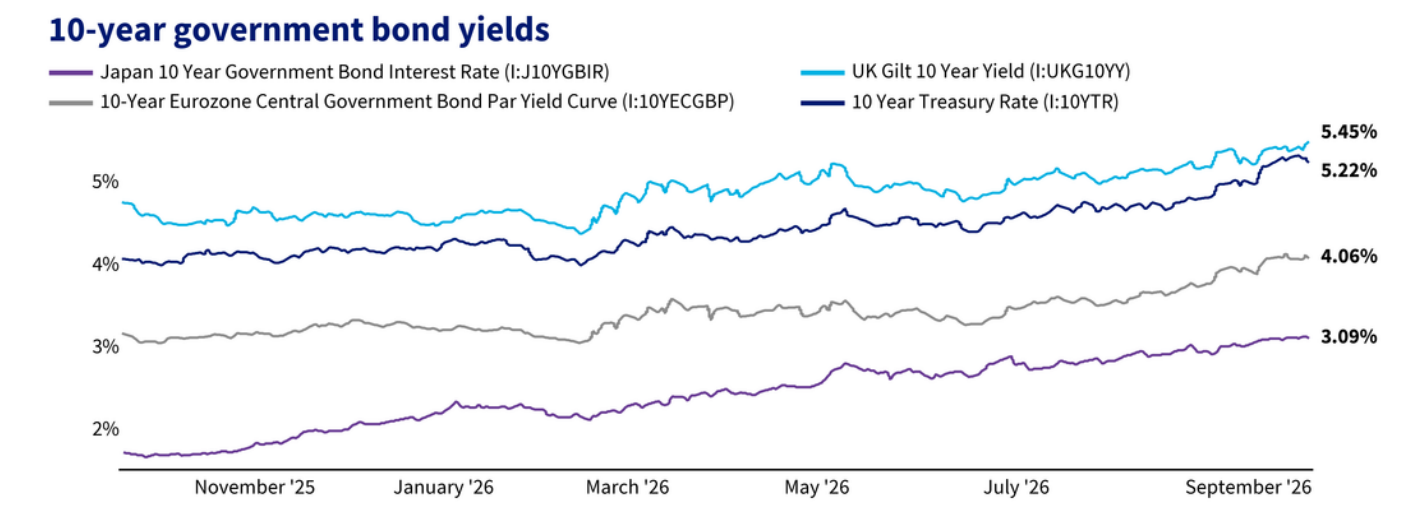
Longer and higher: global 10-year government yields, September 30, 2026. Source: YCharts. Data as of September 30, 2026.
The New Anxiety: Bonds Are the Portfolio Risk
The common market anxiety is that AI will underdeliver. The reality is the opposite: the capital expenditure boom is already locked in by multi-year infrastructure budgets.
The true risk to capital markets is the natural byproduct of this boom: structurally higher interest rates. In an environment of underestimated inflation, bonds, not stocks, become the primary portfolio risk.
A New Economic Struggle: Interest Rate Sensitivity vs. AI Spending
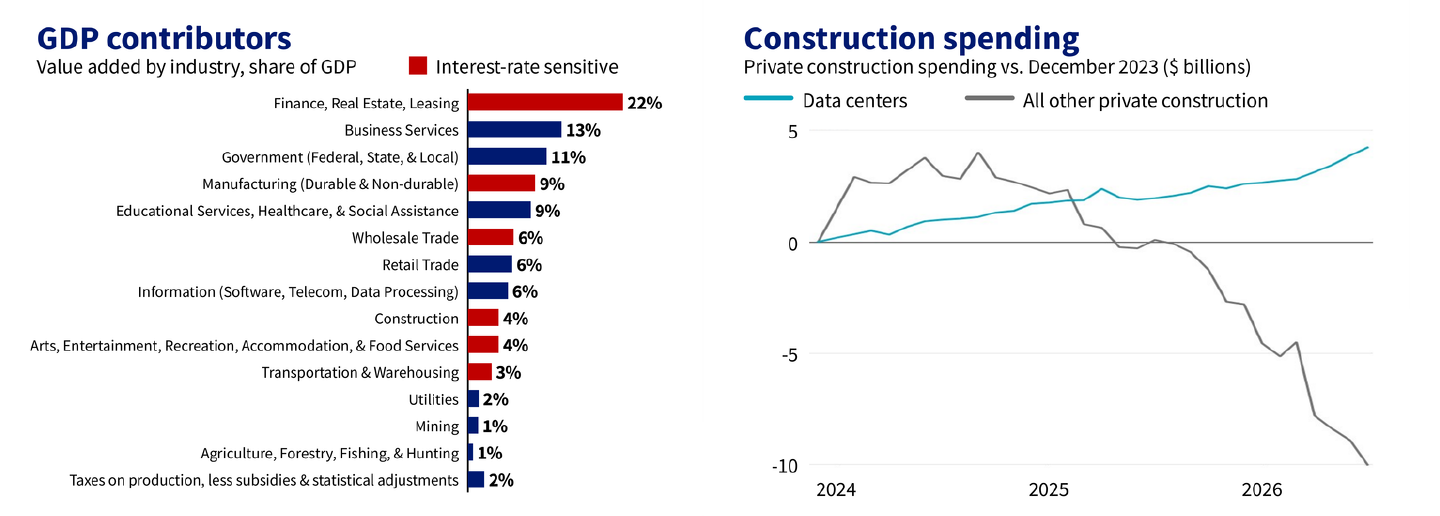
Interest rate sensitivity vs. AI spending. Source: GDP = Federal Reserve Bank of St. Louis “Value Added by Industry”, Construction = The Wall Street Journal “The AI Build is Becoming the Biggest Economic Bet in US History,” September 23, 2026.
Endgame: Rising Rates Impact on the Stock Market
Traditionally, during a rising rate environment, there have been two outcomes:
- Interest rates level off at a higher rate, and then the stock markets and economy are strong enough to absorb the higher rates, but economic growth slows.
- Interest rates continue their trajectory to a point when stock markets take notice and begin to fall. Falling asset prices lead to economic declines and often recessions. It is only then that interest rates start to decline.
In the Meantime: What Is Frontier Doing About It?
Traditional passive fixed-income benchmarks are fundamentally flawed in this regime; they expose investors to severe duration risk exactly when interest rate sensitivity is penalized. “Closet indexing” in fixed income merely captures downside risk while forfeiting the security-selection alpha necessary to navigate volatile bond markets.
At Frontier, we believe navigating this reality requires a shift toward active, multi-manager bond positioning. Blending specialized third-party investment managers with distinct performance patterns can help reduce a portfolio’s reliance on a single macroeconomic outcome, like declining interest rates, to succeed.
Read the full October 2026 Monthly Briefing
Quick answers
Why are bonds the primary portfolio risk right now?
The true risk to capital markets is the natural byproduct of the capital expenditure boom: structurally higher interest rates. In an environment of underestimated inflation, bonds, not stocks, become the primary portfolio risk.
What is driving the current capital expenditure boom?
Unlike typical credit-fueled consumption cycles, this expansion is driven by a synchronized global CapEx boom anchored in three structural themes: AI and hyperscaler buildout, grid pressure, and onshoring.
Why is inflation heating up when the economy is strong?
For the past twenty years, globalization acted as a deflationary force by sourcing from the lowest-cost producers. Today’s pivot toward protectionism removes some of those efficiency buffers, and the physical CapEx cycle places a structural floor under wages and commodity prices.
What happens to stocks when interest rates keep rising?
Traditionally there have been two outcomes. Rates level off at a higher level and stocks and the economy absorb them, but growth slows. Or rates continue until stock markets take notice and begin to fall, which leads to economic declines and often recessions, and only then do interest rates start to decline.
Frontier does not provide tax or legal advice. Please consult with a licensed professional for recommendations pertaining to individual circumstances.
Past performance is no guarantee of future returns. Performance shown represents total returns that include income, realized and unrealized gains and losses. Nothing presented herein is or is intended to constitute investment advice or recommendations to buy or sell any types of securities and no investment decision should be made based solely on information provided herein. There is a risk of loss from an investment in securities, including the risk of loss of principal. Different types of investments involve varying degrees of risk, and there can be no assurance that any specific investment will be profitable or suitable for a particular investor’s financial situation or risk tolerance. Frontier is not responsible for any trading decisions, damages or other losses resulting from this information, data, analyses, opinions or their use. Diversification does not ensure a profit or protect against a loss. All performance results should be considered in light of the market and economic conditions that prevailed at the time those results were generated. Before investing, consider investment objectives, risks, fees and expenses.
Frontier Asset Management LLC is a Registered Investment Adviser with the Securities and Exchange Commission. The firm’s ADV Brochure and Form CRS are available at no charge by request at info@frontierasset.com or 307.673.5675 and are available on our website www.frontierasset.com. They include important disclosures and should be read carefully.