
21 Aug 2026
First Eagle Global and the case for real diversification
July was a solid month for Frontier Strategies, as our multi-layered risk management approach was additive. Most Strategies kept up or outperformed benchmarks during this fractured but narrow market. For the year-to-date and one-year periods, most Frontier Strategies remain materially above their benchmarks.
Frontier Strategies are benefiting from a broadening market, in which asset classes like small-cap stocks and emerging market stocks are experiencing outsized returns.
What worked in July
- Growth strategies, tech-heavy funds, and indexing drove gains in the second quarter but lagged significantly for the month.
- Defensive managers like First Eagle Global and value funds in general were the point of diversification for the month.
- Alternative strategies like covered calls and Victory Market Neutral were additive for the month.
The right mix of funds and strategies
In terms of fund and strategy diversification, our Strategies continue to hold robust combinations of funds with differentiated performance patterns. We have lost less when markets declined and captured enough upside when markets gained to finish mostly ahead of our benchmarks over the one-year period.
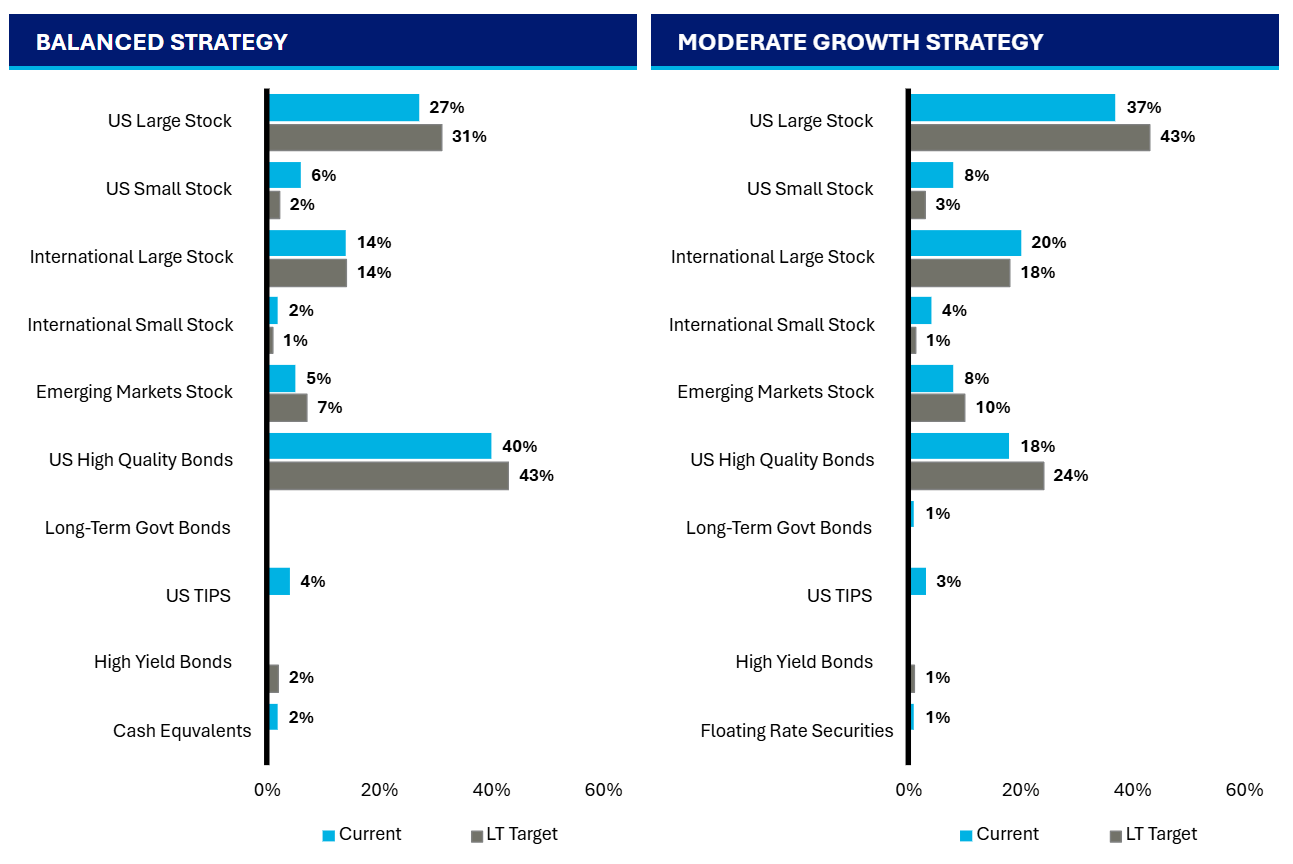
Frontier’s Balanced Strategy and Moderate Growth Strategy: current allocation vs. long-term target.
Source: Frontier Asset Management. Data as of June 1, 2026. Past performance is no guarantee of future returns. Please refer to important disclosure information.
The major performance theme for this year is confirmation of our “strategy” mixes. Because we optimize fund strategies as well as asset allocations, we are effectively combining each fund’s differentiated investment strategy and performance pattern. These patterns are often different from those of the indexes. This “strategy” diversification can be greatly beneficial in difficult markets and can generate excess return over time.
Everybody wants to win when the winning is good, but investors will face a myriad of outcomes over their investment horizons. Proper diversification should account for the multiple market environments that are possible in the future, not just the single path that has occurred in the past.
Mutual fund corner: The Case for First Eagle Global
We are clearly living in a momentum-based investment environment. Thematic story-based stock ideas are thrown around the echo chamber, and investors want in on what is “hot.” Indexes, too, are wholehearted participants, as market-cap weighting rewards whatever has gone up in value. It’s not just the S&P 500 that has become tech-heavy; it is also many other indexes that make up the asset allocation pie charts that the industry puts so much faith in.
Add to that, the idea that stocks and bonds have been correlated in the higher-for-longer post-COVID environment. In down months for stocks, bonds are either leading the way or are dragged down as well.
Where is an investor to go for diversification, which is just another word for taking advantage of change? The last tool left to provide added value in down markets may just be the thing that almost the entire industry has abandoned: active management. True strategy diversification and pure stock selection may be your only hedge to take advantage of change.
Case in point: First Eagle Global. First Eagle Global has long represented defensive equity exposure in our portfolios. And with the market forces competing between momentum and fundamentals, First Eagle has historically been a winner when a momentum-driven market changes direction.
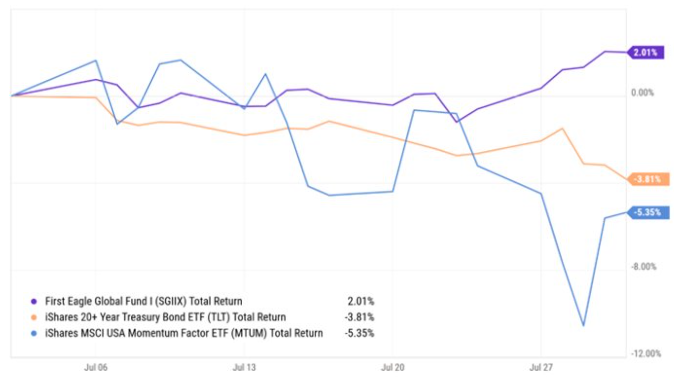
First Eagle Global July performance. Source: YCharts, data as of July 31, 2026.
Strategy diversification is not the same thing as index diversification.
First Eagle Global does not represent a pie slice per se in our portfolios; it represents exposure to those specific businesses that tend to perform well in times of stress.
Quick answers
What is strategy diversification, and how is it different from index diversification?
Index diversification spreads money across sectors by market-cap weight, which can leave a portfolio concentrated in whatever has already gone up. Strategy diversification instead combines funds with genuinely different investment approaches and performance patterns, which tend to respond differently to the same market conditions.
What’s the difference between Frontier’s Balanced and Moderate Growth Strategies?
As of July 31, 2026, the Balanced Strategy currently holds a more conservative mix, roughly 27% U.S. large-cap stock and 40% high-quality bonds, while the Moderate Growth Strategy leans further into equities, roughly 37% U.S. large-cap stock and 18% high-quality bonds, reflecting its longer time horizon and higher return target.
Why did defensive and alternative strategies help Frontier in July?
Defensive managers like First Eagle Global and value funds generally provided diversification during a month when growth and tech-heavy strategies lagged, while alternative strategies like covered calls and Victory Market Neutral were additive on their own.
Is active management outperforming index funds in 2026?
For Frontier Strategies specifically, most kept pace with or outperformed their benchmarks in July, and remain materially ahead for the year-to-date and one-year periods, aided by defensive and alternative strategies that added value when momentum reversed.
Frontier does not provide tax or legal advice. Please consult with a licensed professional for recommendations pertaining to individual circumstances.
Past performance is no guarantee of future returns. Performance shown represents total returns that include income, realized and unrealized gains and losses. Nothing presented herein is or is intended to constitute investment advice or recommendations to buy or sell any types of securities and no investment decision should be made based solely on information provided herein. There is a risk of loss from an investment in securities, including the risk of loss of principal. Different types of investments involve varying degrees of risk, and there can be no assurance that any specific investment will be profitable or suitable for a particular investor’s financial situation or risk tolerance. Frontier is not responsible for any trading decisions, damages or other losses resulting from this information, data, analyses, opinions or their use. Diversification does not ensure a profit or protect against a loss. All performance results should be considered in light of the market and economic conditions that prevailed at the time those results were generated. Before investing, consider investment objectives, risks, fees and expenses.
Frontier Asset Management LLC is a Registered Investment Adviser with the Securities and Exchange Commission. The firm’s ADV Brochure and Form CRS are available at no charge by request at info@frontierasset.com or 307.673.5675 and are available on our website www.frontierasset.com. They include important disclosures and should be read carefully.